CatDog World: After Humans
- 4.4
- Rating
- 1.00M
- Installs
- Free
- Price

 Analysis by App-foxy
I spent time with CatDog World: After Humans as a mobile strategy game, and my first impression was that it aims for a more playful kind of long-term planning than the usual serious war or empire builders. Its world is built around the idea of pursuing legendary paths, searching for hidden treasures, and working toward dominance, but the “CatDog World” identity gives that familiar structure a lighter personality. That contrast is important: the game may appeal to someone who wants strategic decisions without a completely grim presentation.
It is free to download, rated for Everyone, and developed by StarFortune. The game has already passed one million installs and holds a 4.4 average from around twelve thousand ratings, which suggests that it has found a sizeable audience rather than remaining a niche experiment. I would still treat those numbers as a starting point, not a guarantee that it will suit every player. Strategy games can feel very different depending on whether you enjoy patient progress, frequent planning, or quick sessions.
How CatDog World: After Humans feels during ordinary play
The central appeal is the feeling of building toward something larger than the current screen. Instead of treating every action as an isolated match, the game presents progress as a journey: follow a path, uncover valuable discoveries, and gradually become more powerful. That structure makes it a natural fit for players who enjoy checking in, making a few decisions, and returning later with a clearer plan.
You May Also Like

 Pandora - Music & Podcasts
Pandora’s Music Is Easy to Start, but Harder to Recover
Pandora’s strength is its low-effort path from a seed to a station. Its weak spot is how much confidence it asks you to place in connection, setup, and quiet recovery.

 8 Ball Pool
 Is Built on Rivalries, Rematches, and Routine
A close look at the rivalries, rematches, shared routines, and unanswered safety questions that turn a quick pool match into a persistent mobile community.

 Samsung Music
’s Quiet Strength Is Playing What You Already Own
Its reach comes less from spectacle than from dependable access to a personal library. That simplicity is both the app’s strongest retention engine and its ceiling.

 AccuWeather: Weather Radar
AccuWeather Review: A Quick, Clear Forecast for Everyday Decisions
For everyday plans, the best forecast is the one you can understand quickly. AccuWeather makes rain timing, radar, and local conditions easy to act on, with a few trade-offs.

 Hill Climb Racing
Why Hill Climb Racing Still Turns Crashes Into One More Run
A tiny car, a bumpy hill and one more upgrade: Hill Climb Racing keeps resurfacing because its simple chaos makes every near-miss feel personal.

 AliExpress - Shopping App
AliExpress Makes Global Shopping Feel Personal, but Shoppers Bear the Risk
AliExpress turns a global marketplace into a pocket-sized discovery engine. Its reach is useful, its shopping loop compelling, and its trade-offs easy to miss.
More From Our News Desk
View All News


I found the strongest part of that design is the sense of direction. A strategy game can become tiring when it gives you many buttons but no reason to care about the next one. Here, the promise of legendary progress and treasure hunting gives each session a simple question: what should I improve or pursue next? That is more motivating than clicking through upgrades without understanding their purpose.
At the same time, the game is not best approached as a quick arcade title. If you want immediate action, rapid rounds, or a complete experience in five minutes, this is probably not the right category for you. Its appeal comes from gradual decisions and the satisfaction of watching a broader plan take shape. I would recommend it more readily to people who enjoy strategy games as routines rather than one-off bursts of excitement.
What makes the presentation easier to live with
The CatDog setting gives the game a friendlier identity than many mobile strategy alternatives. That matters when you expect to open the app repeatedly over several days or weeks. A lighter theme can make planning and progression feel less demanding, especially for players who are new to strategy games and do not want their first experience to be dominated by military language or an intimidating fantasy rulebook.
However, a playful presentation does not remove the usual commitment of the genre. You still need to pay attention to the choices you make, understand what your current goal requires, and avoid spending resources simply because an option is available. My practical advice is to pause before every major improvement and ask whether it supports the path you are currently following. That small habit helps prevent scattered progress.
One useful way to play is to divide sessions into three parts. I first look at the current objective, then inspect what I can realistically complete, and only afterward spend anything on improvements. This is more efficient than opening the game and immediately claiming or purchasing the first available upgrade. The approach is especially helpful when I am playing during a short break and do not have time to rethink my whole strategy.
Speed expectations and the rhythm of progress
CatDog World: After Humans feels better suited to measured progress than constant rapid-fire input. The important question is not whether every screen changes instantly, but whether the game lets you move from one decision to the next without making the process feel confusing. In my experience, the overall rhythm works best when I enter with a specific task instead of browsing aimlessly.
Players who expect a fast, competitive match may find the pace restrained. That is not automatically a weakness; it is a trade-off. A slower structure gives me more time to consider priorities, but it also means that progress can feel less dramatic when I am impatient. If you prefer strategy titles where one short session produces a clear winner, a traditional match-based game may be a better choice.
For everyday use, I would treat it as a companion game rather than the only game on my phone. A short visit works when I want to make a few decisions, while a longer session is more enjoyable when I have a concrete objective in mind. This avoids the common frustration of expecting every launch to deliver a major breakthrough.
There is also a practical speed tip that is easy to overlook: do not confuse activity with progress. Opening every available option can make a session feel busy without improving your position. I get more from choosing one path, checking what it needs, and postponing unrelated actions. That focus is particularly valuable in a strategy game built around legendary advancement, where spreading attention too widely can make the journey feel slower than it really is.
What happens during heavier play
The most demanding moments are likely to come when I stay in the game for a longer planning session, move through several progression screens, or repeatedly check available goals and rewards. Those moments naturally place more pressure on a phone than a quick visit. I would not judge the game’s everyday performance from a single opening alone; sustained use is where heat, battery drain, or slowdowns would matter most to a real player.
Because the confirmed device requirement reaches back to Android 7.0, the game is not restricted to only recent Android phones. That is encouraging for people using older compatible hardware, but compatibility should not be mistaken for identical performance. A phone that technically meets the operating-system requirement may still feel less comfortable during long sessions than a newer device with more headroom.
My recommendation for heavy use is simple: keep the phone reasonably cool, close unrelated apps if the device is already struggling, and avoid judging the game while the phone is handling several other demanding tasks. These are sensible habits for any mobile title, but they matter especially for strategy games because a small delay during repeated menu navigation can become irritating over time.
I also prefer to play longer sessions when the battery is not already close to empty. That is less about this particular game having a confirmed unusual drain and more about avoiding a poor combination of low battery, background activity, and an older phone. If your device is modest, shorter visits are the safer expectation. The game’s design naturally supports that pattern because its value comes from decisions and progression, not from nonstop reflex play.
Reliability, recovery, and the cost of interruption
Reliability matters more in a progression-based strategy game than in a title where every round starts fresh. If a session is interrupted, I want to know that returning to the game will still make sense and that my previous decisions will not feel wasted. The most useful recovery habit is to leave each session after completing a clearly understood step rather than quitting halfway through a confusing chain of actions.
I also suggest checking your current objective before closing the game. That creates a mental bookmark for the next visit. If you return later and immediately know whether you were pursuing a treasure, building toward a milestone, or preparing the next improvement, recovery feels much smoother. This is a small workflow, but it reduces the friction that often makes long-term strategy games feel like chores.
There is a difference between technical reliability and personal tolerance for repetition. Even if the game opens and responds normally, you may still lose interest if the progression loop feels too similar from one visit to the next. I would therefore recommend giving it several focused sessions rather than deciding after one glance. The first session mainly teaches the shape of the game; the real test is whether its planning loop remains satisfying once the novelty of the setting wears off.
Players should also remember that free games with in-app purchases require a little discipline. Individual purchases range from $0.99 to $99.99, so the financial scale can vary widely depending on what you choose. I would not spend simply to solve a moment of impatience. First decide whether the underlying strategy is enjoyable without extra spending; if it is not, a purchase is unlikely to fix the larger problem.
Device constraints and who should install it
The minimum operating-system requirement is Android 7.0, making the game accessible to a broad range of Android users. Still, older phones may offer a less comfortable experience during extended play, particularly if storage is crowded or the device already struggles with several apps. I would keep expectations realistic: meeting the minimum software requirement means the phone is eligible, not that every session will feel equally smooth.
For someone using a newer mid-range or high-end phone, the greater question is probably not basic access but whether the game’s style matches their taste. Powerful hardware cannot turn a gradual strategy loop into a fast action game. If your priority is visual spectacle, instant combat, or a short competitive match, you may be happier with another category of mobile game. If you like planning, collecting progress, and returning to a developing world, the hardware demand is less likely to be your main concern.
The Everyone age rating also makes it easier to consider for a shared family device, but I would still explain the purchase system before handing the phone to a child. The age label describes the content rating; it does not remove the need for sensible account and spending controls. That is especially important when the available purchase range runs from a small optional amount to a much larger single item.
One of the game’s better use cases is a predictable daily routine. Imagine having ten minutes while waiting for an appointment: instead of beginning a match that you may need to abandon, you can review your current direction, make one or two sensible improvements, and stop at a natural point. That scenario suits the game’s strategic pacing. It is less suitable for a commute where your connection or attention is constantly interrupted and you need a game that can be picked up and dropped every few seconds.
How it compares with familiar strategy alternatives
Compared with match-based strategy games, CatDog World: After Humans appears more focused on ongoing development than on delivering a complete contest in one sitting. That makes it more relaxing for players who like continuity, but less satisfying for someone who wants a clear beginning, middle, and end every time they play. A match-based alternative is better when you want measurable short-term competition.
Compared with large empire-building games, its CatDog identity feels more approachable. The trade-off is that players who specifically want a deep political simulation, complex diplomacy, or a highly detailed war system may find a traditional empire title more rewarding. I would choose this game when I want the broad pleasure of strategic growth without committing to a more severe or complicated presentation.
It also differs from puzzle strategy games, where the challenge is usually a self-contained problem with a precise solution. Here, the satisfaction comes from managing a continuing path and deciding how to use progress over time. If you enjoy finding the one correct move, a puzzle title may offer sharper mental challenges. If you enjoy making reasonable choices under changing priorities, this game is the more natural fit.
The most important comparison is therefore not graphics or popularity but commitment. CatDog World: After Humans asks me to care about the next stage of a journey. Choose it if that continuing relationship with a game sounds appealing. Skip it if you prefer games that respect your time by ending cleanly after every short session.
Version, accessibility, and long-term value
The current version is 1.7.17.1787373186, and the game was released on July 14, 2025. Those details place it firmly in the current mobile-game landscape, while the install count and rating show that it has attracted meaningful attention. I would still focus less on the version number itself and more on whether the present progression loop keeps giving you worthwhile decisions.
Long-term value will depend on your tolerance for repetition and optional spending. The free entry point is helpful because you can test the style before committing money. My preferred approach is to play naturally, learn which goals actually matter to me, and only then decide whether any purchase improves enjoyment rather than merely shortening a wait or easing impatience.
A second advanced habit is to keep a simple priority rule: pursue the objective that unlocks the most useful next choice, not necessarily the one that looks most attractive immediately. Treasure hunting is appealing, but a shiny reward is not always the best use of attention if it pulls you away from the path that gives your overall progress more structure. This is the kind of small decision that separates thoughtful play from constant tapping.
My performance verdict is cautiously positive. StarFortune’s game is most convincing as a steady, accessible strategy experience with a distinctive CatDog setting and a clear sense of long-term pursuit. I like it for short, intentional sessions, and I think it is a reasonable entry point for players who find conventional empire games too stern or complicated.
I would not recommend it to someone seeking guaranteed high-speed action, a finished experience in every sitting, or a strategy game free from purchase pressure. Older devices may also be better served by shorter sessions, even though Android 7.0 support keeps the entry barrier fairly low. For everyone else, the free download makes trying it a sensible decision: spend time learning the rhythm first, keep purchases deliberate, and judge the game by whether its ongoing path keeps you curious.
After using it, I see CatDog World: After Humans as a game for patient planners rather than impatient competitors. Its strongest quality is not a single spectacular moment, but the way it gives ordinary visits a reason to continue. If you enjoy building toward a larger goal, making careful choices, and returning to see how far your path has developed, it is worth a place on your Android device.
FAQs for CatDog World: After Humans
01What is CatDog World: After Humans about?
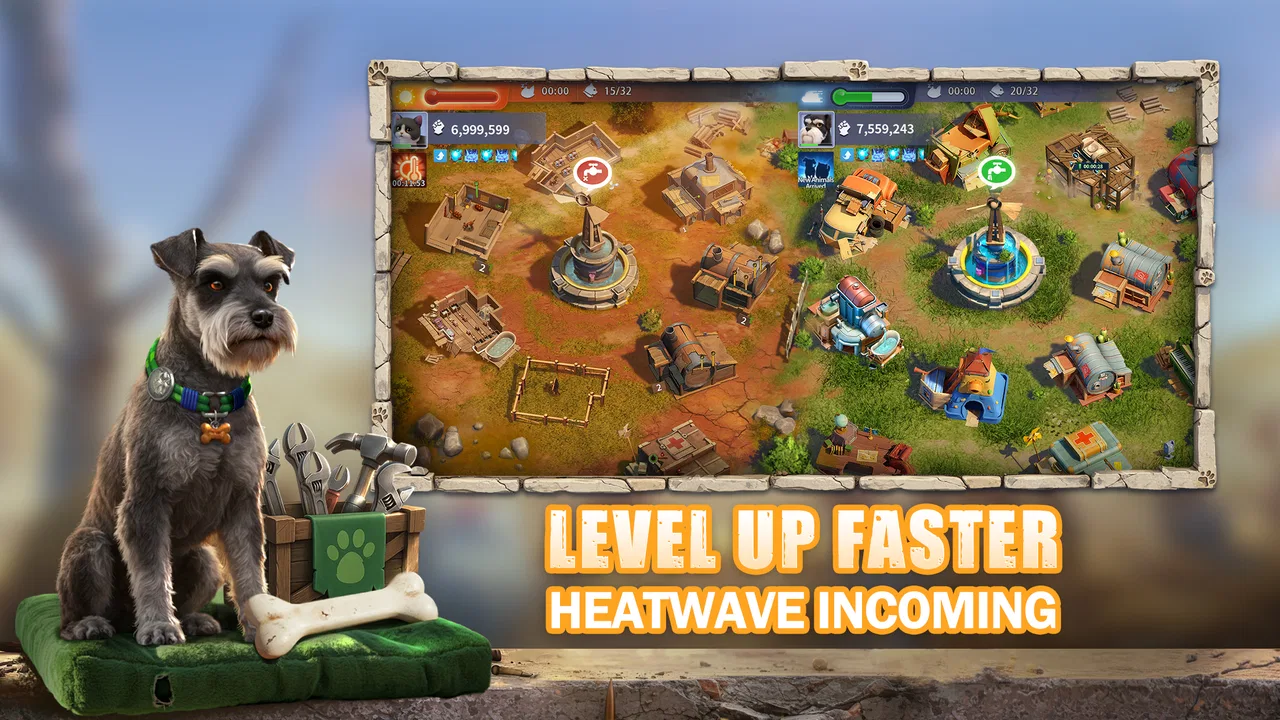
CatDog World: After Humans is an adventure and simulation game set in a world where humans have disappeared. You explore the environment, interact with animal characters, collect useful resources, and gradually uncover what happened to the former inhabitants. The game focuses on exploration, survival-style progression, and discovering new areas rather than following a purely linear story.
02How does the gameplay work in CatDog World: After Humans?
The game combines exploration, resource gathering, light survival mechanics, and interaction with the world around you. You can move through different locations, search for items, complete objectives, and improve your progress as you discover more of the post-human setting. Its pace is generally accessible, although some tasks may require patience, careful exploration, and returning to previously visited areas.
03Is CatDog World: After Humans suitable for children?
CatDog World: After Humans has a colorful animal-based presentation that may appeal to younger players, but parents should still review the game’s content and interaction features before allowing children to play. The overall experience is more focused on exploration and adventure than graphic violence. If the game includes advertising, purchases, or online elements, parental controls are also recommended.
04Can CatDog World: After Humans be played offline?
Offline availability can depend on the version installed and the device being used. Some exploration or single-player features may work without a constant connection, but the game could still require internet access for the first setup, updates, advertisements, account services, or specific online functions. It is best to launch the game once while connected and check which features remain available offline.
05Does CatDog World: After Humans contain ads or in-app purchases?
The presence and frequency of advertisements or in-app purchases may vary according to the Android or iOS version, region, and current update. Before downloading, check the official store listing for the latest pricing and monetization details. If purchases are available, they may provide optional items or convenience features, so users should review the payment settings and use device-level purchase restrictions when necessary.
Pros
- Creative post-apocalyptic world centered on cats and dogs
- Lighthearted humor makes the unusual setting enjoyable
- Animal-focused story offers a refreshing change from human heroes
- Exploration encourages curiosity across varied environments
- Suitable for players who enjoy quirky
- unconventional adventures
Cons
- The premise may feel too whimsical for players seeking serious survival gameplay
- Animal characters may have limited emotional depth for some players
- Exploration can become repetitive if locations lack enough variety
- The unusual art direction may not appeal to every visual preference
- Progress may feel slow for players who prefer faster-paced action

CatDog World: After Humans
Gallery